
iHR Australia Editorial Team
28 Sep 23
Psychosocial risks – the new emphasis on leadership to proactively identify and control them.
Interviewee: Steven Booker, Consulting Psychologist
When it comes to opening up about mental ill health (or reporting on psychosocial risks), many employees have a deep-seated fear of facing criticism, judgement, or discrimination. This fear often compels them to continue to suffer in silence. Justifiably, a study conducted by Diversity Council Australia (DCA)¹ revealed workers who were open about their mental health were two times more likely to report experiencing discrimination and/or harassment at work compared to those who kept their struggles hidden.
But, it’s high time we kick this stigma to the curb and break the mental health taboo in workplaces.
In recent years, many leaders are becoming self-aware and upskilling themselves to better recognise the signs of mental ill-health at work and drive supportive R U OK? conversations. However, some organisations are still missing the mark.
The focus is often on identifying employees experiencing mental ill-health, assessing their fitness for work, providing them with support (if needed), and helping them build resilience. This occurs at the expense of a systems-focused approach that seeks to identify and change aspects of workplace cultures that cause stress in the first place (e.g. psychosocial risk control).
However, the new emphasis in the Australian legal system on proactively identifying and controlling psychosocial risks makes it critical for leaders to shift their thinking and focus on how to:
Safe Work Australia’s (SWA) Model Work Health and Safety Regulations (Regulations) are not legally binding on employers unless their state or territory has implemented them in its own legal system.
For example, NSW has implemented the Regulations summarised below but Victoria has not implemented it as of yet (although the Victorian law does require employers to eliminate/control risks to psychological health).
Safe Work Australia’s (SWA) Managing Psychosocial Hazards at Work code of practice published in July 2023 (Code) is also not legally binding but provides practical guidance to employers for how to comply with their obligations to eliminate or control psychosocial risks.
In summary, the Regulations and Code require employers to, as far as is reasonably practicable, identify and eliminate/control reasonably foreseeable (psychosocial) risks to employee psychological health arising from the design or management of work, the work environment or equipment, or employee interactions/behaviours at work.
A ‘psychosocial risk’ is anything in relation to work (factors, structure or management of work) that may harm an employee’s mental health.
Some of the examples include:
When we closely examine these stress-related factors, a few notable concerns come to light.
According to a Journal article ‘Job autonomy and psychological well-being: A linear or a non-linear Association’² published on Taylor and Francis Online, the study concluded a relevance for job redesign by indicating that higher levels of job autonomy may be beneficial for the psychological well-being of workers. Although some employees have structured roles with high levels of policies or standard procedures to comply with, there is little discretion over how work needs to be completed.
Other research has also indicated that having low control at work may create stress by: restricting an employee’s ability to maximise on their full potential, reducing the coping mechanisms available to employees for managing other job-related stresses, and making it difficult for employees to anticipate challenges or changes.
Similarly, a related psychosocial risk occurs when employees don’t have clear job descriptions or KPIs/competencies/values by which their performance is assessed. This can also lead to a decreased level of control because it can make it hard for employees to know what they are expected to do, how their performance will be assessed, and how their responsibilities are separate from those of their colleagues.
Unreasonable job demands, such as excessive workloads within limited time frames, can cause stress by making employees feel that the demands of their role exceed their ability to cope. When employees perform their tasks in a fashion that involves constantly rushing or being under pressure, this can overwhelm their mental and emotional resources and activate the body’s ‘fight or flight’ (stress) response.
In an article featured on Smart Company³ in February 2023, there was a sincere appeal to organisational leadership to ‘put more thought and collaboration into job design’ to effectively decrease the risk of stress, burnout and mental ill health at work.
Toxic organisational cultures characterised by a lack of support or trust can erode employee perceptions of psychological safety, and create an environment where employees are on constant alert for threats. In turn, this can also activate the chronic stress response. The same can be said about remote work arrangements given that it often provides less scope for employees to get support, and build trusting work relationships.
Psychosocial risks – and how to handle them
In recent times, there has been a significant amount of discussion both in research studies and online forums, including platforms like LinkedIn, regarding the extent to which organisations are evolving to encourage employees to ‘bring their authentic selves to work.’ This issue is particularly critical when addressing mental health challenges, as many employees, as supported by research, often grapple with conditions such as depression silently.
Just as in any change-making process, a shift in the workplace culture related to mental health awareness must begin from the top, and managers should play a more active role in this regard.
Focus on giving employees in your team or organisation more control over how and when their work is done, and more notice of, and input to, decisions and changes that affect them.
Be aware of the key psychosocial risks discussed above, and ensure your organisation has a structured and valid processfor identifying, prioritising and controlling any of those risks in your workplace.
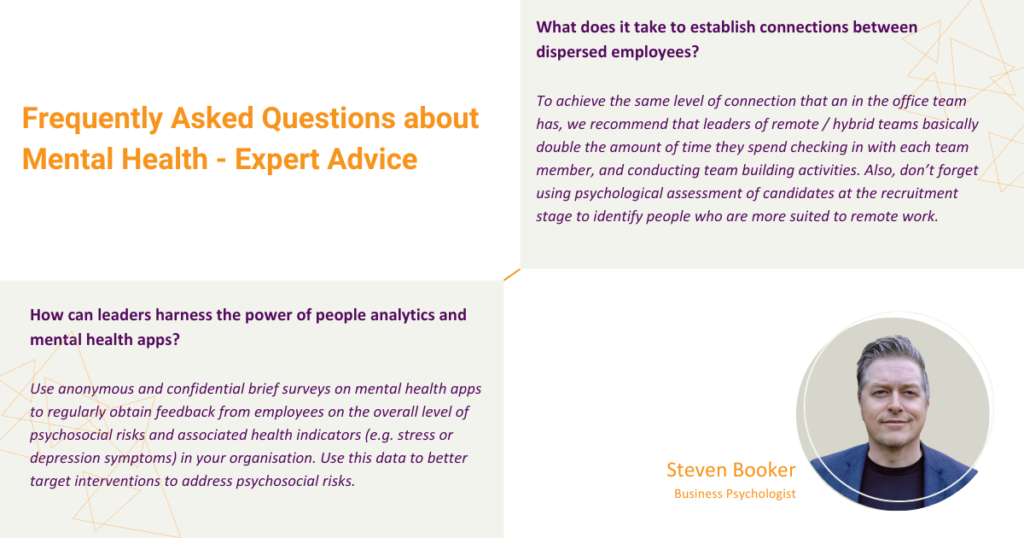
Have a good, practical understanding of how stress and mental ill-health conditions may affect employees’ performance, engagement or communication at work. Check in regularly with your team, and if you see changes in an employee’s behaviour that is unusual for that person, initiate an R U OK? conversation.
Practice authentic leadership and model the behaviour you encourage employees to exhibit. Be open about your own challenges with stress or mental health, as this will normalise discussions about this at work and encourage employees who are struggling to ask for help.
The increased obligations to identify psychosocial risks mean that spotting and taking proactive action to address risks is an essential leadership trait, and this can only be achieved through appropriate mental health and well-being training.
But spotting and acting on psychosocial risks is not a straightforward process because they can sometimes be harder to see or understand than physical risks. Or, we may not be used to considering psychosocial risks as risks at all. For example, we may just expect that having too much work and not enough time to do it is a standard feature of a company or industry we work in.
All leaders would benefit from practical training to help them identify common changes in employees’ performance, engagement, communication or behaviour at work which may indicate high stress levels of possible mental ill-health conditions.
iHR Australia Editorial Team

iHR Australia delivers practical in-house workplace training for employees, people leaders, HR and People & Culture teams, executives and boards.

iHR Australia helps organisations identify, assess and control psychosocial risk at work. We translate psychosocial safety obligations into…