11 Sep 18
How common are mental health conditions among Australian employees?
At any given time 1 in 5 Australian employees will experience a mental health condition. Some conditions are more common such as anxiety, which affects 1 in 3 women. The World Health Organisation predicts that by 2020 depression will replace cancer as the second leading cause of disability and it will be the number one condition causing most disability by 2030 (WHO, 2008).
What is the cost of untreated mental ill-health in the workplace?
The cost to Australian workplaces that do not act to manage mental health is $10.9 billion per year and is accrued in a few ways. One such cost is from paying an employee who is not attending work with the average employee suffering from untreated depression taking on average off 3-4 days per month (PwC, 2014).
Another cost is from employees with mental health conditions working less productively than normal. Also known as presenteeism, this is the largest cost to businesses. The final significant cost is claims resulting from mental health conditions.
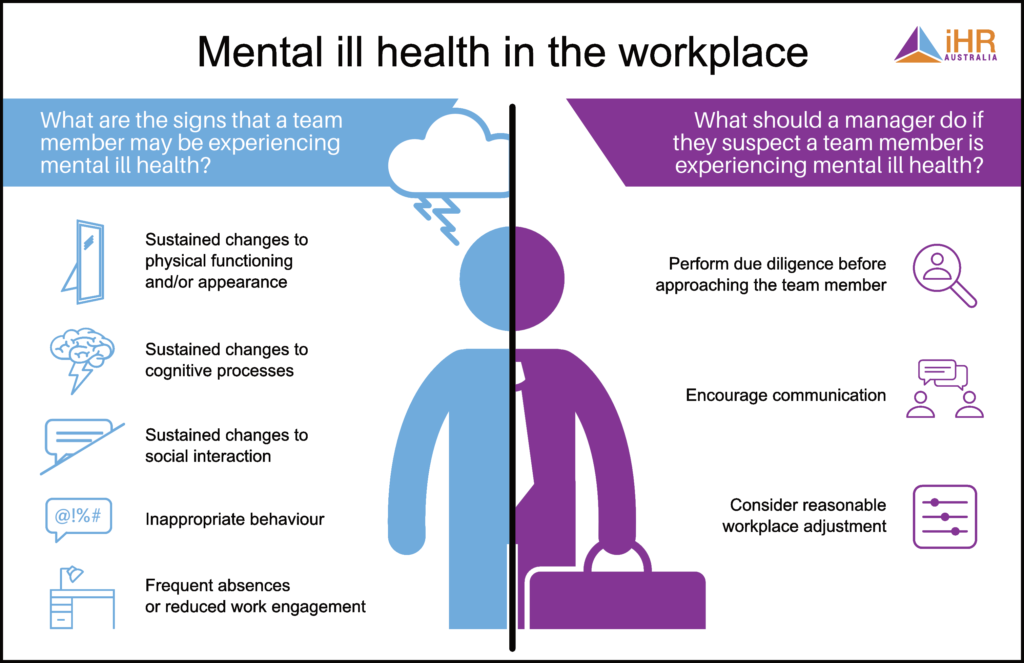
Mental Ill Health in the workplace infographic
How have leaders’ perceptions of workplace mental health changed?
Leaders’ perceptions of mental health in the workplace have changed. In 2008, nearly half of all senior managers believed none of their workers would experience a mental health condition at work. Awareness has improved with over 75% of senior leaders believing that mental health should be a focus in workplaces (beyondblue, 2015). Whilst awareness and perceptions have changed, where do we go from here?
What is the return on investment in workplace mental health?
Investing in mental health and making it a focus in business makes good business sense. For every $1 a business invests in creating a mentally healthy workplace there is a return on investment of $2.30-$5.00, depending on the size of the organisation (PwC, 2014). There is a return on investment because employees with good mental health are likely to take fewer days off, be more productive, or lodge fewer claims.
How can organisations support mental health at work?
Actions to focus on mental health can be addressed through effective mental health initiatives such as:
- Building a positive and safe work culture about mental health including reducing stigma about mental ill-health and addressing risk factors for mental ill-health in the workplace.
- Investing in building and safekeeping the mental health of employees.
- Providing managers / leaders with skills to identify indicators of mental ill-health and how to engage in best-practice management in the context of mental ill-health.
What workplace mental health training is available?
Learn more about iHR Australia’s mental ill health training programs for HR professionals & OHS/WHS practitioners, managers and leaders and employees.
About the author
Dr Kathryn Gilson, Clinical Psychologist
Dr Kathryn Gilson is a clinical psychologist with a Doctorate of Psychology and over 10 years’ experience working in private practice assessing, diagnosing, treating and managing adults with mental health issues.
She has experience working with clients who experience depression and anxiety (including generalised anxiety, panic disorder, social anxiety, phobia, and post-traumatic stress disorder) and many other psychological problems.
In her career as a psychologist, Kathryn has worked extensively within the higher education industry as an adjunct lecturer, contributed to clinical trials by developing innovative treatment manuals for mental health problems, published in peers reviewed journals, presented at national and international conferences, provided expert opinion for magazine articles, and developed evaluation studies of private practice effectiveness using CBT.
Related Content

Psychosocial Risk Management
iHR Australia helps organisations identify, assess and control psychosocial risk at work. We translate psychosocial safety obligations into…

Workplace Training Services
iHR Australia delivers practical in-house workplace training for employees, people leaders, HR and People & Culture teams, executives and boards.